

Our product
Our Products include Spot Welders, Butt Welders, Flash Butt Welders, Seam Welders, Medium Frequency Inverter DC Welders, Single-phase/Three-phase Secondary Rectifier Spot Welder, Wire Mesh Welding Machines, Sink Producing Line, Automatic Argon Arc Seam Welding Machines, High/Ultrasonic/Medium Frequency Induction Heating Machines, and other automatic equipment.
Our certifications
With European CE certification, professional sales and timely after-sales service, our DRAGON brand has gained wide acclaim and good reputation, thus establishing long-term and good cooperative relationships with a large number of customers.
One-stop solution
With rich experience and one-to-one service,we can help you choose products and answer technical questions.
Customer service
We are committed to providing reliable, dependable and consistent workmanship and customer service to all of our customers, you will not only receive high quality work but also high quality service.


What is Wire Forming Machine
Wire forming machinery includes traditional equipment that relies on manual labor, semi-autonomous equipment that utilizes computer-aided manufacturing tools, and fully-automated robotic devices to ease the forming process. These pieces of machinery are used to execute simple and complex forming activities alongside other secondary operations.
Benefits of Wire Forming Machine
Improved time to market
One of the primary advantages of prototype wire forming is its ability to quickly transform design concepts into tangible prototypes. Traditional manufacturing methods often involve time-consuming steps, such as mold making and tooling, which can extend the timeline significantly. In contrast, prototype wire forming bypasses many of these hurdles by allowing for quick adjustments and modifications.Furthermore, the speed of prototype wire forming enables companies to test multiple design variations and concepts in a shorter time frame. This iterative approach promotes innovation by encouraging designers to explore unconventional ideas without the fear of extensive time and cost investments.
Complex geometries
Innovation often involves pushing the boundaries of what’s possible. Prototype wire forming enables the creation of complex and intricate geometries that would be challenging to achieve using traditional manufacturing methods. The precision and flexibility of CNC machines allow designers to explore novel shapes and forms that were previously considered impractical or cost-prohibitive.
Enhanced cost efficiency
Managing costs during product development is a perpetual challenge for businesses. Prototype wire forming offers significant cost advantages over traditional manufacturing techniques.One key cost-saving factor is the elimination of expensive tooling and molds. Traditional manufacturing often necessitates the creation of molds, which can be costly, time-consuming, and may require adjustments. In contrast, wire forming relies on digital designs and CNC machines, which significantly reduces setup costs.
Increased customizability
Customization and personalization are key drivers of product innovation. Customers expect products that cater to their unique preferences and needs. Prototype wire forming plays a pivotal role in enabling this level of customization.Because wire forming allows for the creation of highly detailed and tailored prototypes, designers can develop products that meet specific customer demands. Whether a custom-designed automotive component or a personalized medical device, prototype wire forming empowers businesses to deliver products that resonate with their target audience.
Application of Wire Forming Machine
Medical Uses
Parts for the medical industry have to be durable, smooth, and exceptionally clean. The main metal used for the manufacture of medical components is stainless steel since it can withstand high temperatures and multiple cleanings as well as sterilization. The smooth surface of stainless steel protects against nicks, cuts, and punctures to medical workers gloves and garments.
Industrial Uses
Industrial operations require quick efficient precision methods for performing assembly and manufacturing procedures. Wire formed baskets are important for the rapid delivery of parts to production in an organized and convenient way.
Automotive Uses
Wire forming in the automotive industry includes various types of wire springs, as well as compression coils and volute springs for suspension applications. Delicate springs, like torsion and tension springs, have multiple purposes, such as swing down tailgates. Conical springs are used in the production of battery contacts.
Athletic Uses
Masks are wire formed as a protection for contact sports and are made to comply with the National Operating Committee Standards for Athletic Equipment (NOCSAE).
Telecommunications Uses
Steel wire is used for guides and trays because of its smooth surface. The open design allows for ease of access to cable installation, inspection, and upgrades. Routing rings can be attached to frames to handle any form of wire due to the strength of the wire frame. Trays, troughs, and support hardware are made for easy cable management with routing rings and tie bars.
Retail Uses
A common use of wire forming in retail is product display racks that are lightweight but sturdy
enough to hold products for customer inspection. They can be placed at cash registers as point of purchase displays or in multiple locations throughout the store. Their light weight makes it easy to relocate them to high-traffic aisles. Wire racks are also a convenient way for storing merchandise for future sales and conducting inventory.
Types of Wire Forming Machine
3D wire forming machinery
This refers to CNC 3D wire forming machines that are used for high-speed and precision manufacturing or forming of 3D wire forms. This equipment is capable of executing operations such as threading, punching, piercing, and heading when required. Above is an image of a 3D wire forming machine courtesy of BLM Group.
2D wire forming machinery
This refers to 2-dimensional CNC-forming machines for making 2D wire forms. The machine utilizes cutting, punching, and piercing tools.
Tabletop benders
Desktop or tabletop bending machines are used for smaller wire welding tasks and may include the use of either a hydraulic or pneumatic system to provide the necessary bending force.
Four-slide machines
The four-slide machine is used to produce small stamped wire forms for large-volume production runs. The machine includes a stamping press and an electric motor to execute stamping operations.
Spring coiling machinery
Spring coiling machinery could refer to either manual coilers or CNC spring coilers. These pieces of equipment are used to produce a variety of custom wire forms and springs. Spring coilers with multiple axis-2, 4, 6, and 8 axis-are used to form pieces of wire with varying diameters. These axes provide wire forming companies with independent control of tooling positions to develop complex forms.
Components of Wire Forming Machine
Wire Feeding Mechanism
This part of the machine is responsible for feeding the wire from a coil or spool into the bending area.Wire feeding mechanisms can include rollers, pulleys, or servo-driven motors that control the wire's movement.
Straightening Unit
Before bending, the wire may pass through a straightening unit, which ensures that the wire is free from kinks and bends.This step helps produce precise bends by starting with a straight wire.
Bending Head and Tooling
The bending head contains the tools and dies needed to shape the wire.Tooling includes various components such as clamps, rollers, and mandrels that hold and shape the wire according to the desired design.
Guide Rollers and Pulleys
These components help guide the wire through the bending process, ensuring it follows the correct path and angles.
Control Panel or Interface
CNC wire bending machines are typically equipped with a control panel or computer interface.Operators input the design specifications, such as bend angles, lengths, and shapes, through this interface.
Computer Control System
The heart of the CNC wire bending machine is its computer control system.It interprets the design specifications and converts them into precise movements and commands for the machine.CNC software programs are used to create and store the bending instructions.
Carbon steel alloys
Carbon steel alloys are widely used in wire forming for springs and high-strength parts. Carbon steel is conductive, very strong, and inexpensive. The hardness and strength of carbon steel increase as more carbon is added-high carbon steel wire is often called music wire. However, higher carbon steels are more brittle and less flexible, making low carbon steel more appropriate for applications such as low-stress springs. Carbon steel is also prone to rusting, so it is not suitable for parts intended for a moist environment.
Stainless stee
Stainless steel includes quantities of chromium and other metals, making it more resistant to rusting than carbon steel.
Copper
Copper is strong and more flexible than steel. It is also an excellent conductor and has high thermal conductivity, making it ideal for electrical applications.
Bronze is corrosion
Bronze is corrosion-resistant and an excellent conductor. It is often used in the manufacture of conductive springs.
Aluminum
Aluminum resists corrosion and is lighter and more flexible than steel, although not as strong.
Nickel
Nickel is highly resistant to corrosion and is stable across a wide temperature range. The nickel alloys used in wire forming are non-magnetic and poor electrical conductors, making nickel a suitable alternative to steel when non-magnetic components are required.
How to Choose Wire Forming Machine
Output power
Pay attention to the output power of the wire forming machine. The output power varies depending on the model specification and output power. Some are only used for bending steel wires for auto parts, but some models are suitable for forming and bending metal wires such as daily hardware and furniture hardware;
Performance and function
It is necessary to master the performance and function of the wire forming machine. If the performance is not very good, a series of minor problems will occur during the entire operation, which will harm the application of the machine;
Productivity
The second one is the category where the productivity of the wire forming machine can be adjusted. The productivity is actually determined based on the accuracy of the product. Fast does not necessarily mean good. Sometimes productivity will damage the quality of the product. Bending angle of view, bending accuracy;
Processing technology
The processing technology and manufacturing industry categories of wire forming machines are not universal, and the application fields are generally around the customer's cost. If one machine can be used for multiple purposes, it will be a good product.
Process types of Wire Forming Machine
Pneumatic Wire Forming
This method uses a straightening machine to shape it to the required design. It involves inserting the wire in the straightening machine and pneumatically cutting it to attain the desired length.
Hydraulic Wire Forming
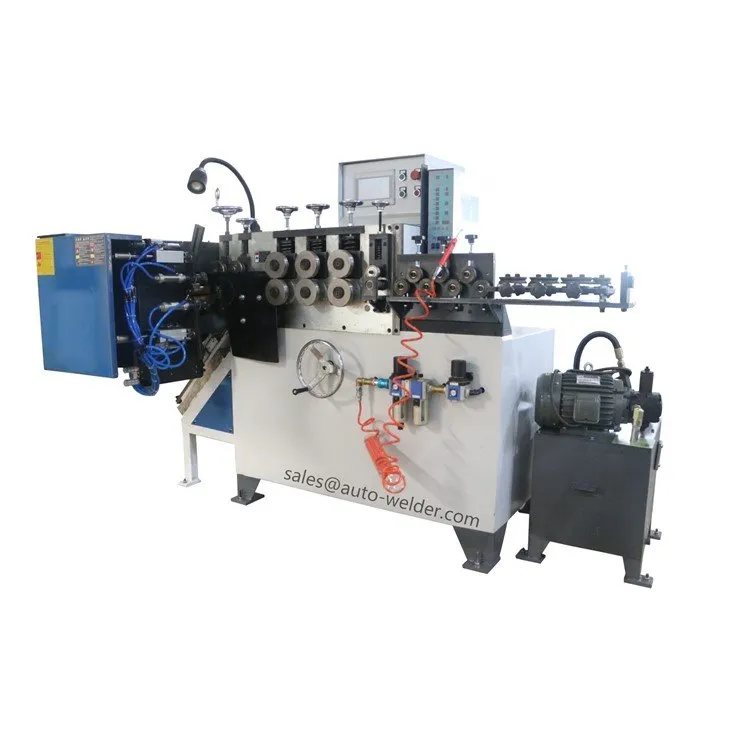
This method uses a hydraulic motor to run the shaping rollers for designing the wires. The hydraulic wire forming procedure uses a CNC programming machine and a servo motor to attain the apt configuration. The equipment automatically discharges the required wire shapes on completion.
Four Slide Wire Forming
This approach is a stamping style that utilizes stamping equipment with four slides. The tool has four slides that carry out the primary bending function. The slides are in a square arrangement, but the four-slide machine can have additional slides for feeding, cutting, and other tasks.
Bending Wire Forming
The wire bending approach allows manufacturers to shape wires into unlimited shapes and configurations to suit different uses. This method does not require secondary finishing and has no waste or scrap since the manufacturer bends the wire before cutting it.
Roll Wire Forming
This approach can be a cost-effective wire-forming option for producing round flat wire forms. Therefore, it suits manufacturing threads, collars, surface finishes, grooves, chamfers, pointing, knurls, and undercuts. Roll wire forming produces products with extra strength, thanks to the hardening process.
Coil Wire Forming
Spring or coil wire forming methods involve winding the wire around a blank metal. The procedure is typical for manufacturing electrical coils for applications that include wounding a conductive wire around a ferromagnetic core. The coil winding process may vary based on the required final product.
Step 1: Wire Drawing
Before the wire goes through the wire bending machine for forming, it needs to be drawn. Wire drawing works by pushing a wire through a die and pulling it out of the other end. As a result, the thickness of the wire, or cross-section, is reduced.Wire drawing changes the shape of metal with force, this process is also known as forging. Forging does not change any characteristic of the metal except for the shape.A spooler is a tool used at the end of the wire drawing process that winds or spools wires. Some wires are spooled and then used in the final form, whereas others still go through the wire forming process.Coilers are similar to spoolers but instead of just wrapping a wire around a spool, they coil the wire into an individual coil, such as a solenoid, or around a centerpiece.
Step 2: Wire Straightening
Next in the wire forming process is wire straightening. The wire straightening process is exactly what it sounds like-a method for straightening out any defects in the wire. During straightening, disfigurements and deformities are rolled out manually or through a CNC machine. Once the wire is fully strengthened, it is then ready for wire forming.
Step 3: Wire Forming
Finally, step three is where the actual wire forming happens. There are a few processes of forming that are done with a manual or automated machine.Manual wire bending machines get their name from the caveat that they require manual labor, even if they are partially automated. The manual process may be manually moving the machine, manually turning the wire, or manually adjusting throughout the procedure. With the accessibility of integrated and intelligent technology moving into the machining industry, manual wire forming is becoming outdated. This process is tedious, requires manpower, and takes exponentially longer than an automated method.
Step 4: Finishing
After forming, sometimes finishing is required for the final product. The finishing step in the wire forming process may involve one or multiple processes that affect a wire's corrosion resistance, electrical conduction, appearance, or other qualities.
How to Maintain Wire Forming Machine
Proper Installation of wire forming machine
The wire forming machine needs to be installed and placed correctly because we all know that installing this kind of equipment is very important, but it is also something we cannot ignore. Avoid dry and ventilated places.
Regularly adding oil to the wire forming machine
The purpose of refueling is for better use in the later period. Generally, the location of refueling is mainly in places such as crimping, wire feeding box, and transmission gear. After refueling, the lubrication of the equipment can be ensured, and the operation is more convenient without causing any problem.
Keep the surface of wire forming machine clean
Before we go down every day, there must be some stains in the equipment that has been working for a day. After stopping the operation, the surface should be wiped properly. If it is not cleaned for a long time and oil stains accumulate, there is a possibility that the circuit parameters may change.
The correct method of operation
This is very important. No matter which type of equipment it is, the correct operation method is required to avoid damage to the equipment and the tool so that the quality of the product has been better guaranteed.

Our Product
GUANGZHOU DRAGON WELDING CO., LIMITED is a professional automatic welding equipment manufacturer, which specializes in designing, producing, sale and service together.Our Products include Spot Welders, Butt Welders, Flash Butt Welders, Seam Welders, Medium Frequency Inverter DC Welders, Single-phase/Three-phase Secondary Rectifier Spot Welder, Wire Mesh Welding Machines, Sink Producing Line, Automatic Argon Arc Seam Welding Machines, High/Ultrasonic/Medium Frequency Induction Heating Machines, and other automatic equipment.Main applied to metal welding of Automobile Parts Manufacturing, Aerospace and Aviation Parts, Road and bridge construction, Electrical Appliance, Hardware Manufacturing, Pressure Vessel, Battery, Refrigeration Industries, and so on.

Certificate


FAQ
As one of the leading wire forming machine manufacturers and suppliers in China, we warmly welcome you to buy durable wire forming machine made in China here from our factory. All machines and equipment are with high quality and competitive price.
Table Spot Welder, Straightening And Cutting Machine