

What is the role of sensors in modern butt welding equipment?
Leave a message

Hey there! As a supplier of butt welding equipment, I've seen firsthand how sensors have become game - changers in this industry. In modern butt welding equipment, sensors play a multitude of crucial roles that enhance the welding process in terms of quality, efficiency, and safety.
Let's start with the basics. Butt welding is a process where two pieces of metal are joined end - to - end. This is widely used in various industries, from manufacturing to construction. And sensors are like the eyes and ears of the butt welding equipment, constantly monitoring and adjusting the process to ensure a perfect weld every time.
One of the primary roles of sensors in butt welding equipment is to measure and control the temperature. Welding involves a significant amount of heat, and getting the temperature just right is essential for a strong and durable weld. Temperature sensors, such as thermocouples, are placed near the welding area. They continuously send data about the temperature to the control system of the welding equipment. If the temperature is too high, the control system can reduce the power input to the welding electrodes. On the other hand, if it's too low, more power can be supplied. This real - time temperature control helps prevent issues like over - heating, which can cause the metal to become brittle, or under - heating, which results in a weak weld.
Another important aspect is the pressure control. During butt welding, the two metal pieces need to be pressed together with the right amount of force. Force sensors are used to measure the pressure applied between the electrodes and the workpieces. These sensors ensure that the pressure remains consistent throughout the welding process. If the pressure is too low, the metal pieces may not bond properly, leading to a poor weld. If the pressure is too high, it can deform the workpieces. By constantly monitoring the pressure, the equipment can make adjustments to maintain the optimal force for a high - quality weld.
Sensors also play a key role in detecting the alignment of the workpieces. Misaligned workpieces can lead to uneven welds and weak joints. Optical sensors or laser sensors are often used to check the alignment of the two metal pieces before and during the welding process. These sensors can detect even the slightest misalignment and send signals to the equipment's control system. The control system can then adjust the position of the workpieces or the electrodes to ensure proper alignment. This not only improves the quality of the weld but also reduces the risk of defects and rework.
In addition to quality control, sensors contribute to the efficiency of the butt welding process. For example, proximity sensors can detect when the workpieces are in the correct position for welding. Once the workpieces are in place, the sensors send a signal to start the welding process automatically. This reduces the time wasted on manual positioning and start - up procedures. Moreover, sensors can monitor the speed of the welding process. By measuring the rate at which the metal is being joined, the equipment can adjust the welding parameters to optimize the speed without sacrificing quality. This results in higher productivity and lower production costs.
Safety is another area where sensors are invaluable. Current sensors are used to monitor the electrical current flowing through the welding electrodes. Excessive current can pose a safety hazard, such as electrical shocks or overheating of the equipment. If the current exceeds a safe limit, the sensors can trigger an alarm or shut down the welding equipment immediately. Similarly, gas sensors can detect the presence of harmful gases, such as carbon monoxide, which may be produced during the welding process. If the gas levels reach a dangerous level, the sensors can activate ventilation systems or stop the welding operation to protect the operators.
Now, let's talk about some specific types of butt welding equipment and how sensors are used in them. We offer a range of butt welding machines, including the Bandsaw Blade Butt Welder. In this machine, sensors are used to ensure the precise alignment of the bandsaw blade ends. The temperature sensors control the heat input to create a strong and seamless weld, which is crucial for the performance of the bandsaw blade. The pressure sensors make sure that the blade ends are pressed together firmly during the welding process.
Our Steel Bar Butt Welder also relies heavily on sensors. For steel bars, the alignment and pressure control are of utmost importance. The sensors in this machine continuously monitor the position of the steel bars and the pressure applied during welding. This helps in creating a uniform and strong weld along the entire cross - section of the bars.
The Steel Ring Butt Welding Machine uses sensors to handle the unique challenges of welding steel rings. The sensors detect the circular shape and ensure that the ends of the ring are properly aligned and welded. Temperature sensors control the heat to prevent the ring from warping during the welding process.
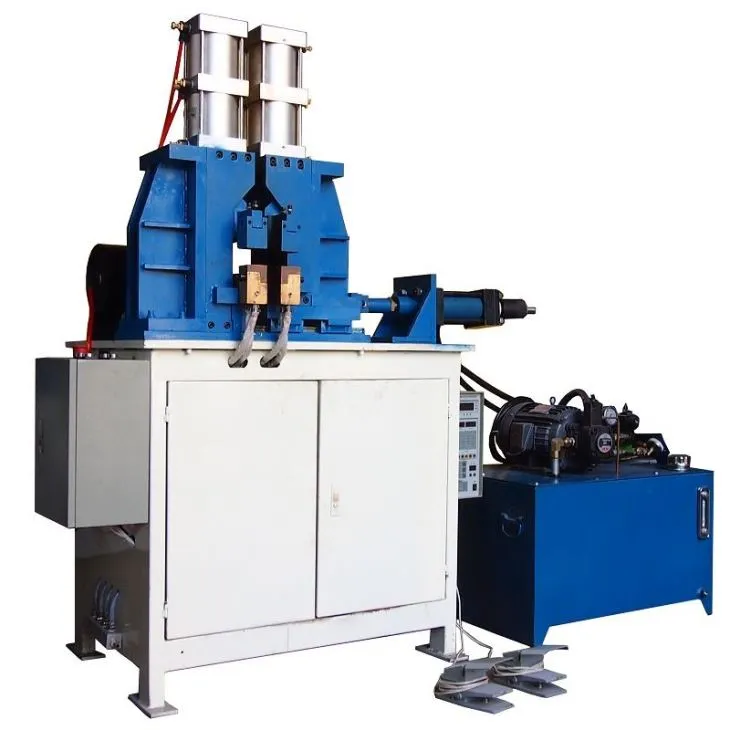

In conclusion, sensors are an integral part of modern butt welding equipment. They improve the quality of the welds, increase the efficiency of the welding process, and enhance the safety of the operators. If you're in the market for high - quality butt welding equipment, we're here to help. Our machines are equipped with the latest sensor technology to provide you with the best welding solutions. Whether you need a bandsaw blade butt welder, a steel bar butt welder, or a steel ring butt welding machine, we have the right equipment for your needs. Don't hesitate to reach out to us for more information or to discuss your specific requirements. Let's work together to achieve the perfect weld!
References
- Welding Handbook, American Welding Society
- Sensor Technology in Industrial Automation, Springer Publishing


