

What is the heat affected zone in Flash Butt Welding?
Leave a message

Hey there! As a supplier of Flash Butt Welding equipment, I often get asked about the heat affected zone (HAZ) in Flash Butt Welding. So, I thought I'd take a few minutes to break it down for you.
First off, let's talk about what Flash Butt Welding is. It's a type of resistance welding where two metal pieces are joined together by heating them at the joint through electrical resistance and then applying pressure. This process is super efficient and is used in a wide range of industries, from automotive to construction.
Now, onto the heat affected zone. The HAZ is the area of the base metal that hasn't melted but has had its mechanical properties changed because of the heat from the welding process. When the welding current flows through the metal pieces, it generates a whole lot of heat at the joint. This heat spreads out into the surrounding metal, causing changes in the microstructure of the material.
The size and characteristics of the HAZ depend on several factors. One of the main factors is the welding current. If the current is too high, it'll generate more heat, and the HAZ will be larger. On the other hand, if the current is too low, the joint might not be properly formed. Another factor is the welding time. A longer welding time means more heat is transferred to the metal, which can also increase the size of the HAZ.
The type of metal being welded also plays a big role. Different metals have different thermal conductivities and melting points. For example, metals like copper have high thermal conductivity, which means the heat spreads out quickly, resulting in a relatively larger HAZ. In contrast, metals with low thermal conductivity, like stainless steel, tend to have a smaller HAZ because the heat doesn't spread as easily.
The HAZ can have both positive and negative effects on the welded joint. On the positive side, in some cases, the heat can cause the metal in the HAZ to become harder, which can improve the strength of the joint. However, there are also negative aspects. The changes in the microstructure can lead to a decrease in ductility and toughness. This means the welded joint might be more prone to cracking or failure under stress.
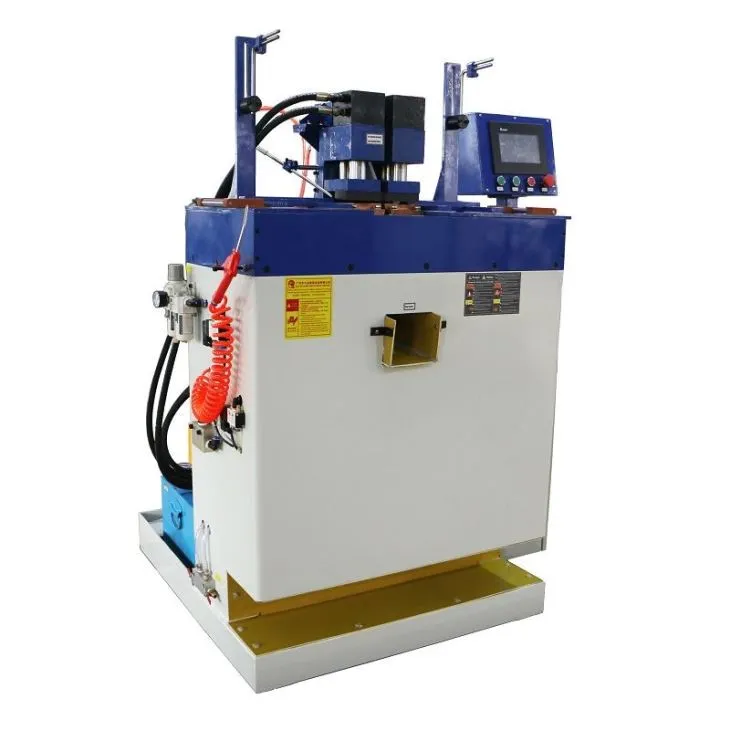
As a supplier, we understand the importance of controlling the HAZ in Flash Butt Welding. That's why our Flash Butt Welding Machine is designed with advanced control systems. These systems allow us to precisely regulate the welding current and time, which helps in minimizing the size of the HAZ.
Let's take a look at some specific applications. In the construction industry, Rebar Butt Welding Machine is used to join rebars. The HAZ in this case needs to be carefully controlled because the rebars need to have sufficient strength and ductility to withstand the loads in a building. If the HAZ is too large and the ductility is reduced, it could compromise the structural integrity of the building.
Another application is in the manufacturing of bandsaw blades. Our Bandsaw Blade Butt Welder is specifically designed for this purpose. The HAZ in bandsaw blade welding is crucial because the blade needs to be sharp and flexible. A large HAZ can make the blade brittle and more likely to break during use.

To sum it up, the heat affected zone in Flash Butt Welding is an important aspect that needs to be carefully managed. By understanding the factors that affect the HAZ and using the right equipment, we can ensure high - quality welded joints.
If you're in the market for Flash Butt Welding equipment and want to learn more about how we can help you control the HAZ in your welding processes, don't hesitate to reach out. We're here to answer your questions and discuss how our machines can meet your specific needs. Whether you're a small - scale workshop or a large industrial manufacturer, we've got the right solution for you. Let's start a conversation and see how we can work together to improve your welding operations.
References
- Welding Handbook, American Welding Society
- Principles of Resistance Welding, George E. Linnert


