What are the inspection methods for the welded joints made by butt welding equipment?
Leave a message

When it comes to the manufacturing and industrial sectors, butt welding is a crucial process that joins two pieces of metal end - to - end. As a leading supplier of Butt Welding Equipment, we understand the significance of ensuring the quality of welded joints. In this blog, we will explore various inspection methods for the welded joints made by butt welding equipment.
Visual Inspection
Visual inspection is the most basic and commonly used method for evaluating welded joints. It is a non - destructive testing (NDT) technique that can be carried out with the naked eye or with the help of simple magnification tools.
The inspector looks for obvious defects such as cracks, porosity, lack of fusion, and excessive spatter. Cracks can occur due to factors like high residual stress, improper welding parameters, or the presence of impurities in the base metal. Porosity appears as small holes in the weld, which can result from gas entrapment during the welding process. Lack of fusion means that the weld metal has not properly bonded with the base metal, and excessive spatter is the unwanted expulsion of molten metal during welding.

Visual inspection is quick and cost - effective. It can be done immediately after welding, allowing for rapid identification of major defects. However, it has limitations. Some internal defects may not be visible to the naked eye, and the inspector's skill and experience play a significant role in the accuracy of the inspection.
Dye Penetrant Inspection
Dye penetrant inspection (DPI), also known as liquid penetrant inspection, is another non - destructive testing method. It is used to detect surface - opening defects in welded joints.
The process involves applying a liquid penetrant to the surface of the weld. The penetrant, which is usually a brightly colored or fluorescent liquid, is allowed to seep into any surface - opening defects for a specified period. After the penetration time, the excess penetrant is removed from the surface, and a developer is applied. The developer draws the penetrant out of the defects, making them visible as bright indications against the background of the developer.
DPI is highly sensitive and can detect very small surface cracks. It is relatively simple to perform and can be used on a variety of materials. However, it is only effective for surface - opening defects and cannot detect internal flaws.
Magnetic Particle Inspection
Magnetic particle inspection (MPI) is suitable for ferromagnetic materials, such as steel. It is used to detect surface and near - surface defects in welded joints.
In this method, a magnetic field is applied to the welded part. If there is a defect present, the magnetic field will be distorted, creating a leakage field at the surface. Fine magnetic particles are then applied to the surface. These particles will be attracted to the leakage field, forming a visible indication of the defect.
MPI is fast and relatively inexpensive. It can detect both surface and near - surface defects. However, it is limited to ferromagnetic materials and may not be able to detect defects that are parallel to the magnetic field lines.
Ultrasonic Testing
Ultrasonic testing (UT) is a widely used non - destructive testing method for detecting internal defects in welded joints. It works by sending high - frequency sound waves into the weld. When the sound waves encounter a defect, such as a crack or a void, a portion of the waves is reflected back.
The reflected waves are detected by a transducer, and the time taken for the waves to travel to the defect and back is measured. Based on this time and the known velocity of sound in the material, the location and size of the defect can be estimated.
UT is capable of detecting internal defects that are not visible on the surface. It can be used to inspect thick welds and can provide detailed information about the size and location of defects. However, it requires skilled operators, and the interpretation of the test results can be complex.
Radiographic Testing
Radiographic testing (RT) uses X - rays or gamma rays to inspect the internal structure of welded joints. The weld is placed between a radiation source and a radiation - sensitive film or detector. The radiation passes through the weld, and any defects present will absorb or scatter the radiation differently from the surrounding material.
On the film or detector, the defects appear as darker or lighter areas, depending on their density compared to the base material. This allows the inspector to visualize internal defects such as cracks, porosity, and lack of fusion.
RT can provide detailed images of the internal structure of the weld. It is suitable for detecting a wide range of defects in various materials. However, it involves the use of ionizing radiation, which poses health risks to operators and requires strict safety measures. It is also relatively expensive and time - consuming.
Application in Our Butt Welding Equipment
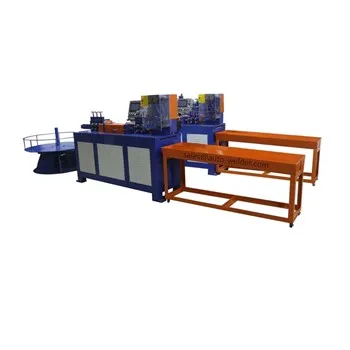
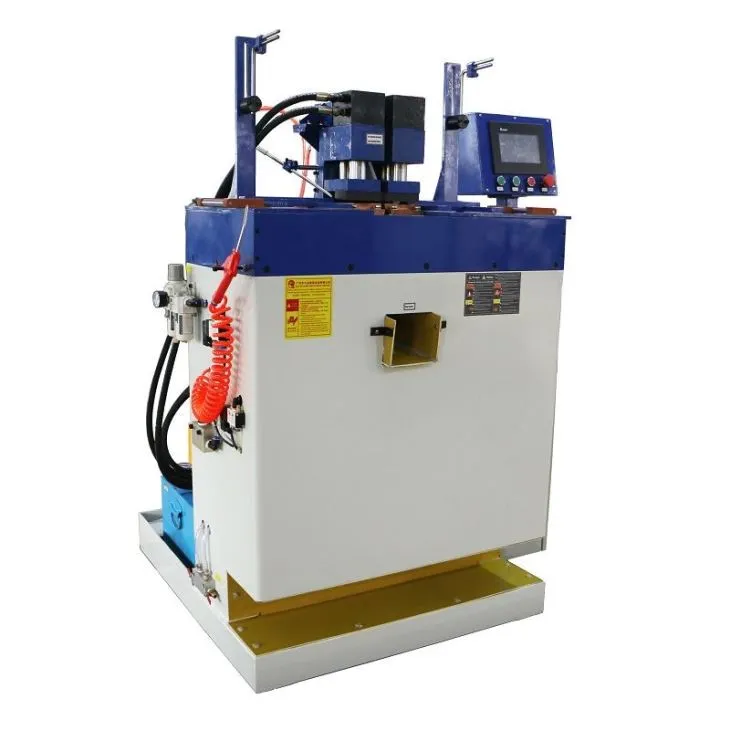
As a supplier of butt welding equipment, including the Steel Ring Butt Welding Machine, Flash Butt Welding Machine, and Bandsaw Blade Butt Welder, we understand the importance of ensuring the quality of the welded joints produced by our machines.
We recommend a combination of inspection methods depending on the specific requirements of the application. For example, in high - quality applications where safety is a major concern, we suggest using a combination of ultrasonic testing and radiographic testing to thoroughly inspect the internal structure of the weld. For less critical applications, visual inspection and dye penetrant inspection may be sufficient.
Our technical support team is always available to provide guidance on the appropriate inspection methods for the welded joints made by our equipment. We can help customers set up inspection procedures and train their operators to ensure accurate and reliable inspection results.
Conclusion
The quality of welded joints is essential for the performance and safety of the final product. As a butt welding equipment supplier, we are committed to providing not only high - quality welding machines but also the knowledge and support needed to ensure the quality of the welded joints.
By using a combination of different inspection methods, manufacturers can detect and address defects in welded joints early in the production process, reducing the risk of product failures and costly rework.
If you are interested in our butt welding equipment or need more information about the inspection methods for welded joints, we encourage you to contact us for procurement and further discussions. Our team of experts is ready to assist you in finding the best solutions for your welding and inspection needs.
References
- American Welding Society. Welding Handbook, Volume 6: Welding Inspection and Metallurgy.
- ASNT (American Society for Nondestructive Testing). Nondestructive Testing Handbook, Volume 1: Ultrasonic Testing.
- ISO standards related to welding and non - destructive testing, such as ISO 17635:2016 for general principles for NDT of welded joints.